
Planning Scheme Amendment VC277 was introduced on 18 December 2025 and makes significant changes to the statutory car parking requirements associated with planning permit applications across Victoria.
Overview
The Amendment seeks to align car parking rates in the planning scheme with actual demand for individual uses and introduces a new tiered system that reduces car parking requirements in locations with better access to commercial facilities and public transport.
Previously, car parking rates for land-uses have generally been standardised across the state, with little differentiation between areas that are remotely located and those that are well-serviced by public transport or within activity centres.
The Amendment incorporates new online maps, available via VicPlan (see below), that segment land into four categories.
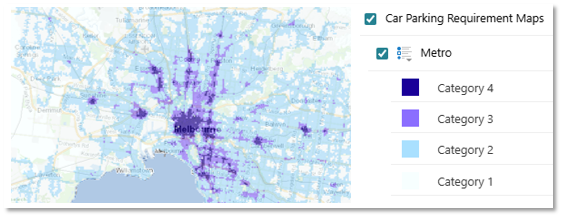 Figure 1: Extract from VicPlan, Car Parking Requirements Map
Generally speaking, Category 1 is land furthest from activity centres with poor access to public transport. Category 4 is generally land within proximity to activity centres with great access to transport alternatives. These four categories are now used in the car parking tables of Clause 52.06 to set new, tiered, car parking requirements for land uses.
Additional Key Points
Practitioners also should note:
- The new tiered system includes both a “minimum” and “maximum” car parking requirement for some uses in some locations. A planning permit is required to exceed any maximum parking requirement specified.
- In Category 4, no minimum parking provisions are set – only maximum requirements. Meaning, there is no minimum parking requirement under the scheme in these locations. Once again we note, that if the maximum specified is exceeded a planning permit will be triggered for the excess parking.
- For some land-uses, the “Measure” for calculating parking requirements has changed. For example, previously the measure for calculating the statutory parking requirement for a childcare centre was 0.22 spaces ‘per child’. Under the new provisions the car parking rate is ‘per employee’ (with the minimum requirement varying depending on which land category applies).
A Few Practical Examples of the Changes
The following provides an overview of the changes for some common planning permit applications:
Multiple Dwellings

For multi-dwelling developments, a development containing 11 x 4 bedroom dwellings could have previously required 24 car parks (2 parks per dwelling and 2 additional visitor-spaces) to meet the requirements under Clause 52.06. Under the new provisions (if located on Category 2 land) a total of only 11parking spaces are required to meet the statutory requirements. It is also noteworthy that dwelling developments no longer require any ‘visitor’ parking onsite.
Childcare

A centre with the capacity for 100 children, under the old Clause 52.06 would’ve required 22 parking spaces. However, if the maximum number of staff for that centre was 25 employees and the land was in a Category 2 area, the requirement under the new Clause 52.06 would only be 12 carparking spaces.
Medical Centre
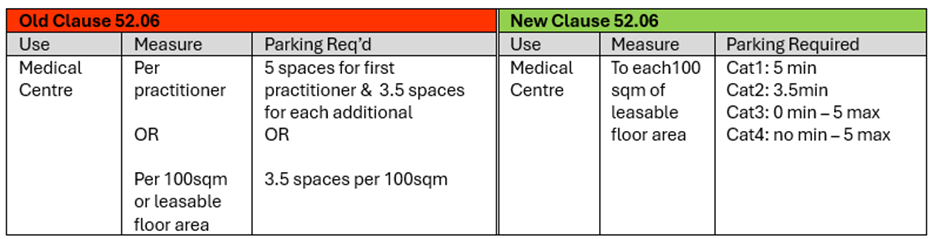
Therefore, a 400sqm medical centre with 8 practitioners may have required 29 parking spaces (5 spaces for the first and 3.5 spaces for each additional practitioner), under the old Clause 52.06. However, under the new Clause 52.06 (if the land was in a Category 2 area) the statutory requirement is reduced to only 14 spaces.
It is apparent from the above examples that these changes can significantly reduce the parking requirements for some uses in some location.
Additional Considerations
Under the new Clause 52.06 exemptions for new uses on land with:
- Established car parking dispensations below the minimum rates, and now
- Car parking rates which exceed maximum rates,
will continue to apply.
A new set of information requirements and decision guidelines are provided for applications that wish to exceed a stated maximum car parking requirement.
Parking overlays will continue to apply, where relevant.
Transitional Provision
The transitional provisions at Clause 52.06-12 are generally favourable to applicants and:
- Generally, allow applications lodged prior to June 18, 2026 to use the old Clause 52.06 parking requirements, if they result in a lower statutory parking demand than the new provisions
- Specify that new ‘maximum’ parking requirements (other than those specified in a Parking Overlay) do not apply to planning permit applications lodged prior to Dec 18, 2025, and
- Confirm that Parking Overlays that reference the statutory parking demand specified in Clause 52.06-5 (Table 1) will continue to be taken as a reference to the former Clause 52.06-5, unless the Overlay specified otherwise.
Closing
Amendment VC 277 includes very significant changes to the way car parking demand will be assessed under Victoria’s planning regime. Practitioners should carefully review existing and pending applications to ensure the benefits of Amendment VC277 are incorporated into your proposals.
Permit holders should look at existing approvals and determine whether a better outcome might now be achievable under the new VC277 considerations.
Should you have any queries with regards your existing or pending planning permit applications and how Amendment VC 277 may affect them please do not hesitate to contact our office.
Subscribe to receive regular updates on planning issues relevant to Victorian planning permit applicants here.
Seek Professional Advice
Information contained in this publication should be considered as a reference only and is not a substitute for professional advice. No liability will be accepted for any loss incurred as a result of relying on the information contained in this publication. Seek professional advice in specific circumstances.
Copyright
If you would like to reproduce or use for your own purposes any part of this publication please contact enquiries@clause1.com.au for assistance.
Clause1 Pty Ltd
Phone: 03 9370 9599
Email: enquiries@clause1.com.au